
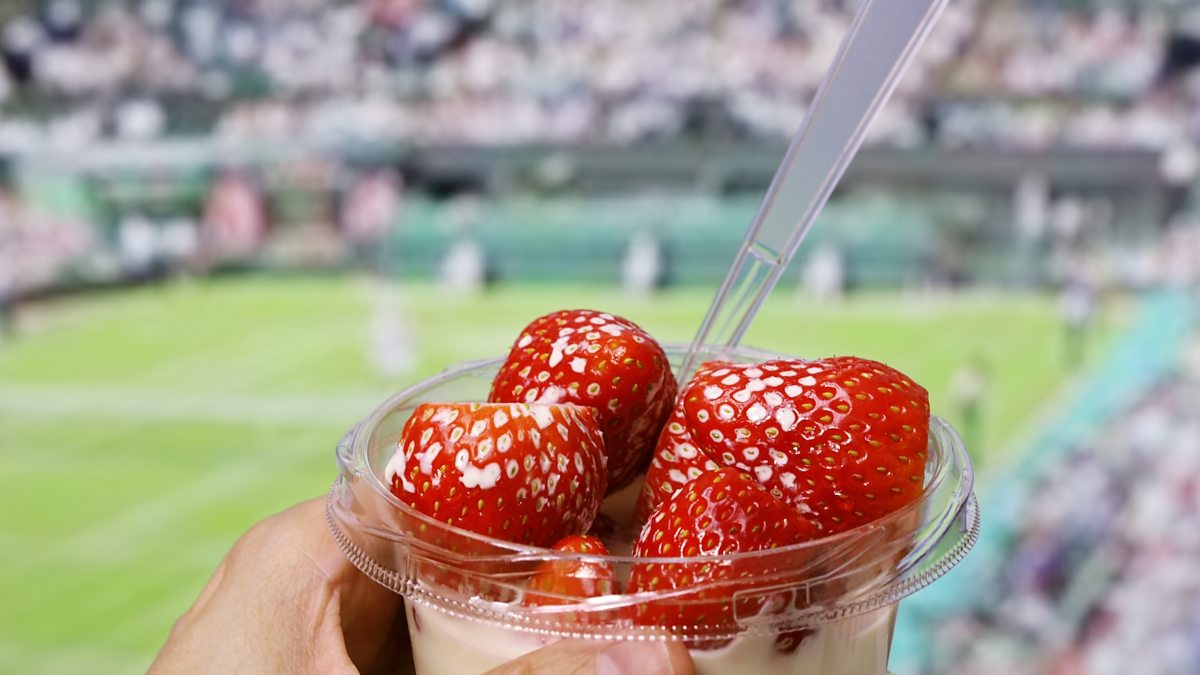
Wimbledon starts on Monday. Which means — somewhere in Kent, at a family-run farm called Hugh Lowe Farms — punnets of Grade 1 Elsanta strawberries are already being readied for their 5.30am drive to SW19. The All England Club gets through 140,000 of them across the fortnight, washed down with 10,000 litres of cream. (And, less famously, 445 kilos of raspberries.)
I've been to Wimbledon once. My mum used to enter in the ticket ballot every year — I never bothered, never really thought I'd actually get anything — then one year she put MY name in for me. Somehow we got tickets and not just any tickets but tickets to the men's singles final! 2016. Andy Murray against Milos Raonic. By the time the day rolled around, those tickets had a resale value of at least £3,000 each. We couldn't let it go to waste. I took my wife (mum was not, it has to be said, entirely thrilled about this decision.) We sat six rows from the front, which meant that every time the cameras went close on Murray or Raonic serving, you could see us in the background. My phone, throughout the match, was a small but unrelenting riot of friends and family texting to say there's a bloke at Wimbledon who looks exactly like you.

Anyway. Murray won. We ate strawberries.
For most people who haven't had a mum quite that useful, the bit you really need from Wimbledon is happening for free in fields right across the country, this week and next. British strawberry season is here, and it's much shorter than the supermarket aisle would have you believe.
A few things you may not know about a strawberry...
It isn't actually a berry. Botanically, the strawberry is something called an "aggregate accessory fruit" — the fleshy red bit is a swollen flower base, and the proper fruit is all those little yellow specks on the outside. Those aren't seeds. Each one is itself a tiny fruit, called an achene, with the actual seed tucked inside. So a single strawberry is, technically, two hundred-odd fruits clinging to a glorified flower bottom. Which is the kind of thing it pays not to think about too much while you're eating one.
It's also a member of the rose family — first cousin to the apple, the peach, and the almond. The big plump strawberry you and I know is a relative newcomer, only about 270 years old, born by accident in Brittany in the 1750s when a North American species and a Chilean one were grown next to each other and decided to get acquainted. Before that, English strawberries were the size of a small grape — woodland strawberries, foraged rather than farmed.
And on the cream side: strawberries and cream as a pairing predates Wimbledon by about three centuries. Cardinal Wolsey served the combination at Hampton Court Palace in the early 1500s, looking for a way to feed a vast court something fresh and manageable. The Victorians inherited the tradition, the first Wimbledon picked it up in 1877, and we've never really put it down.
So far, so trivia. Here's the bit that actually matters.
I should at this point admit something slightly awkward, given that I'm writing a thousand words about them. I don't really like berries. Jams I'll eat. Cordials I'll drink. Anything berry-flavoured in cake form, yes please. But the actual berries — raspberries, blueberries, blackberries — leave me a bit cold. Strawberries are the only real exception, and even then I'm only enthusiastic when there's a worrying amount of cream involved. Cherries I'm fine with, but I maintain the Ch instead of the B means they're not really berries, so they don't count.
The reason I'll concede to the strawberry, and why I think anyone reading this should care: a strawberry doesn't ripen meaningfully after it's picked. Sweetness develops on the plant, in the sun, and once a strawberry leaves the stem the clock has more or less stopped. This is why the strawberries that travel furthest taste the least of anything — they're picked underripe so they survive the journey, and they arrive at your local supermarket genetically engineered to look beautiful and taste of cold water. A proper English strawberry, eaten within a day or two of picking, is a different fruit entirely. There's perfume. There's depth. The flavour goes back along the tongue rather than staying on the surface. If you've never eaten one warm off the plant, do yourself the favour this summer.
The way to do this properly is to find a Pick Your Own. PYO season runs roughly mid-June to mid-July across most of the country — a tight four-week window — and there are still a healthy number of farms doing it. A few practical notes if you've never been: go early in the day, before the sun has done its worst to the fruit. Wear something you don't mind staining. Don't try to fill the punnet — fill it half full and eat the rest as you go (this is, as far as I can tell, the whole point). And bring some double cream home with you, not whipped, not clotted. Wimbledon are right about this.
If you want help finding a PYO near you, the myfoody directory is the obvious place to start — search your postcode, look for farm shops, several of them run PYO alongside. Or look up Hugh Lowe Farms themselves, if you're anywhere near Maidstone, and eat the same fruit they're serving up at SW19 this weekend. There's something rather lovely about that.
Either way: four weeks. Don't miss it.