
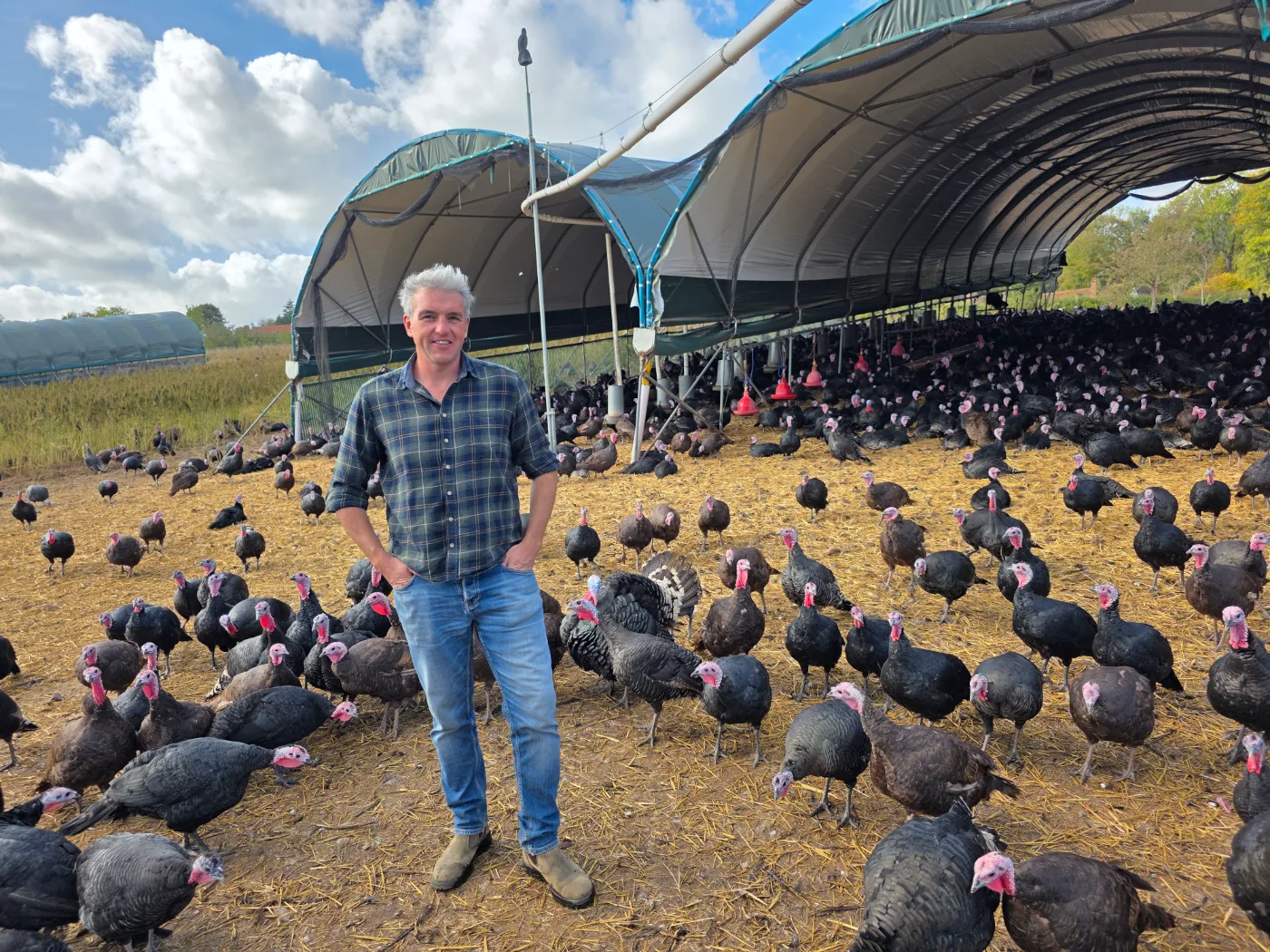
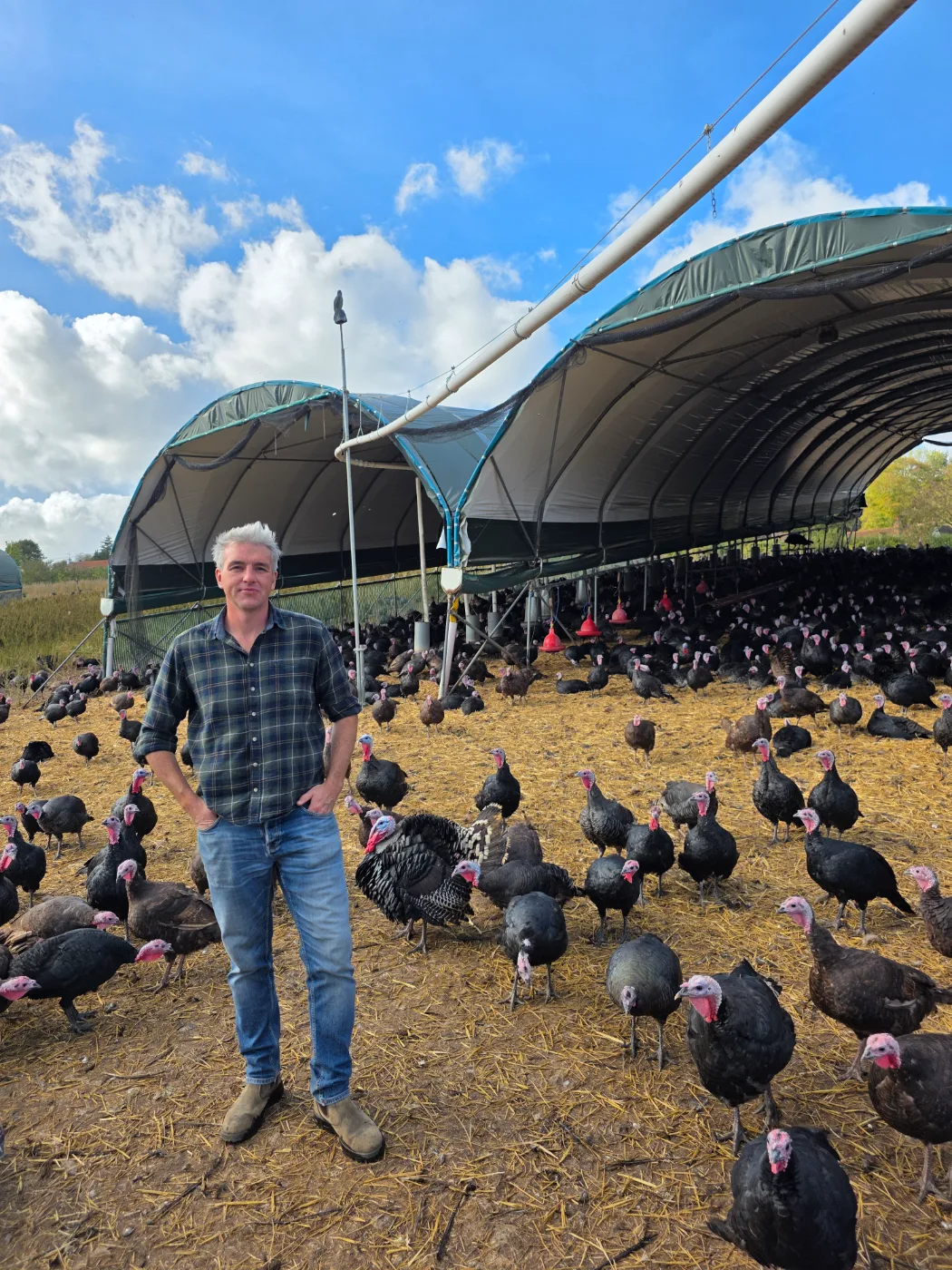
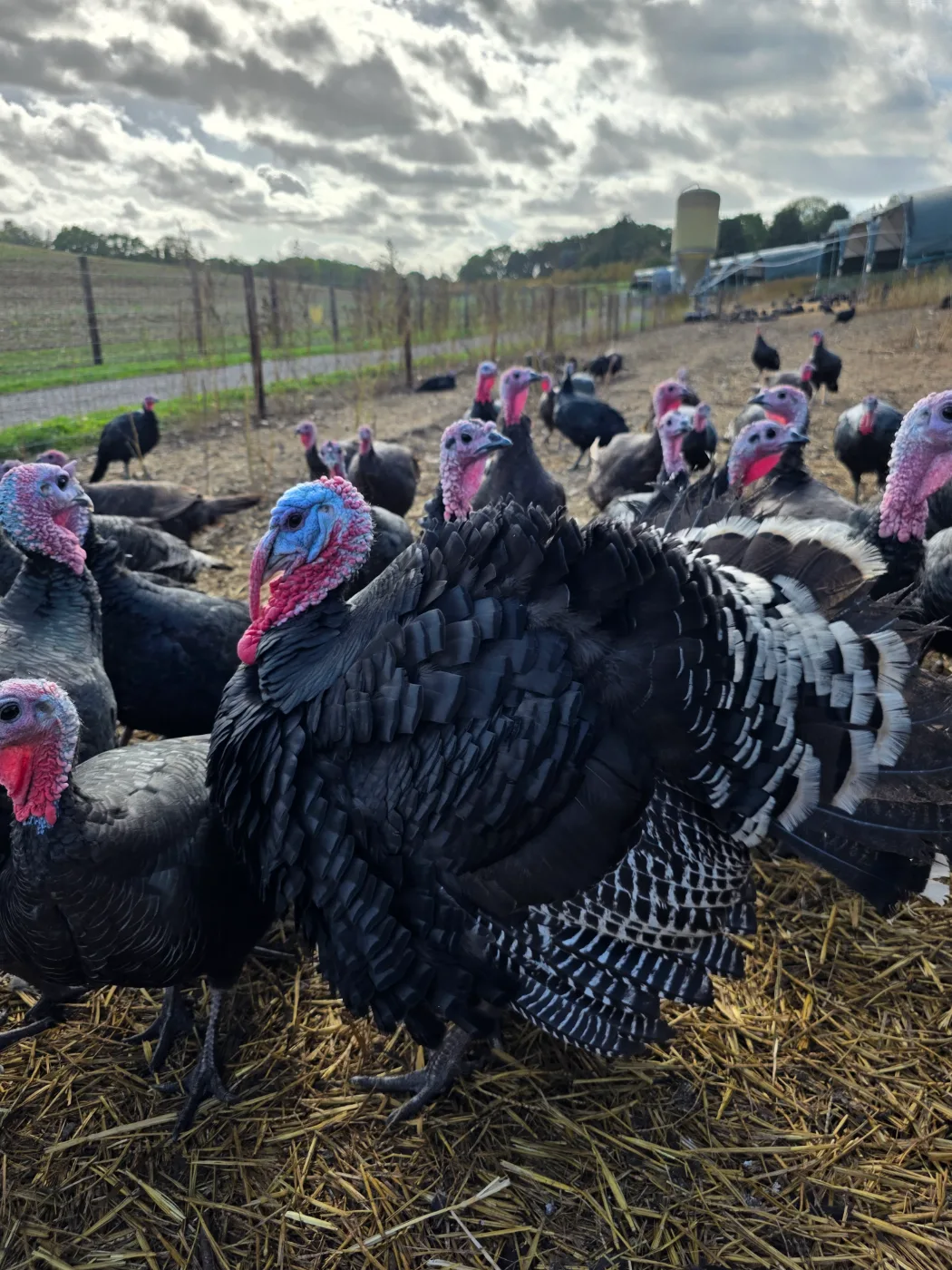
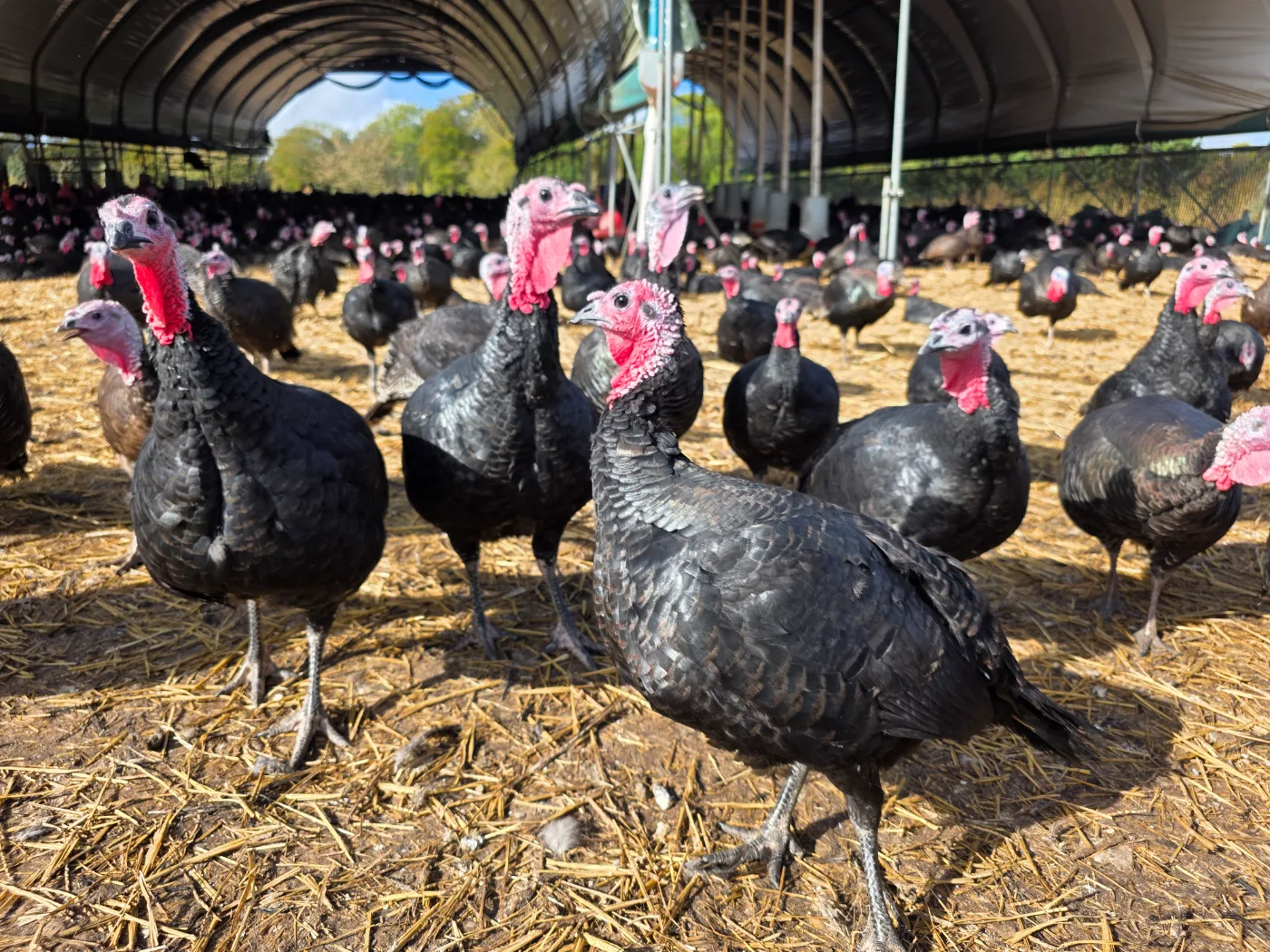
Stand in a field of Copas turkeys and within a minute or two you're surrounded. Nobody rushes you. They drift over in ones and twos, slowly, until there's a neat semicircle of bronze birds standing about a foot away and staring at you. It isn't about food, because there's food behind them the whole time. They just want to know who you are.
"I always say my healthy, happy turkeys are curious turkeys," says Tom Copas. "They're agile, they're moving around, and they'll go, 'Oh, what's going on over there? This is new, let's have a look.'"
I've been writing about producers for myfoody all year, and I'm obsessed with Christmas, so Copas was always going to be on the list. I cooked one of their turkeys last year. This autumn I got to see where it came from: a walk round the farm at Cookham with Simon, who looks after their marketing and has been there nine years, and then an hour on a call with Tom himself, who was far more generous with his time than the diary allowed.
153 turkeys to keep a boy out of trouble
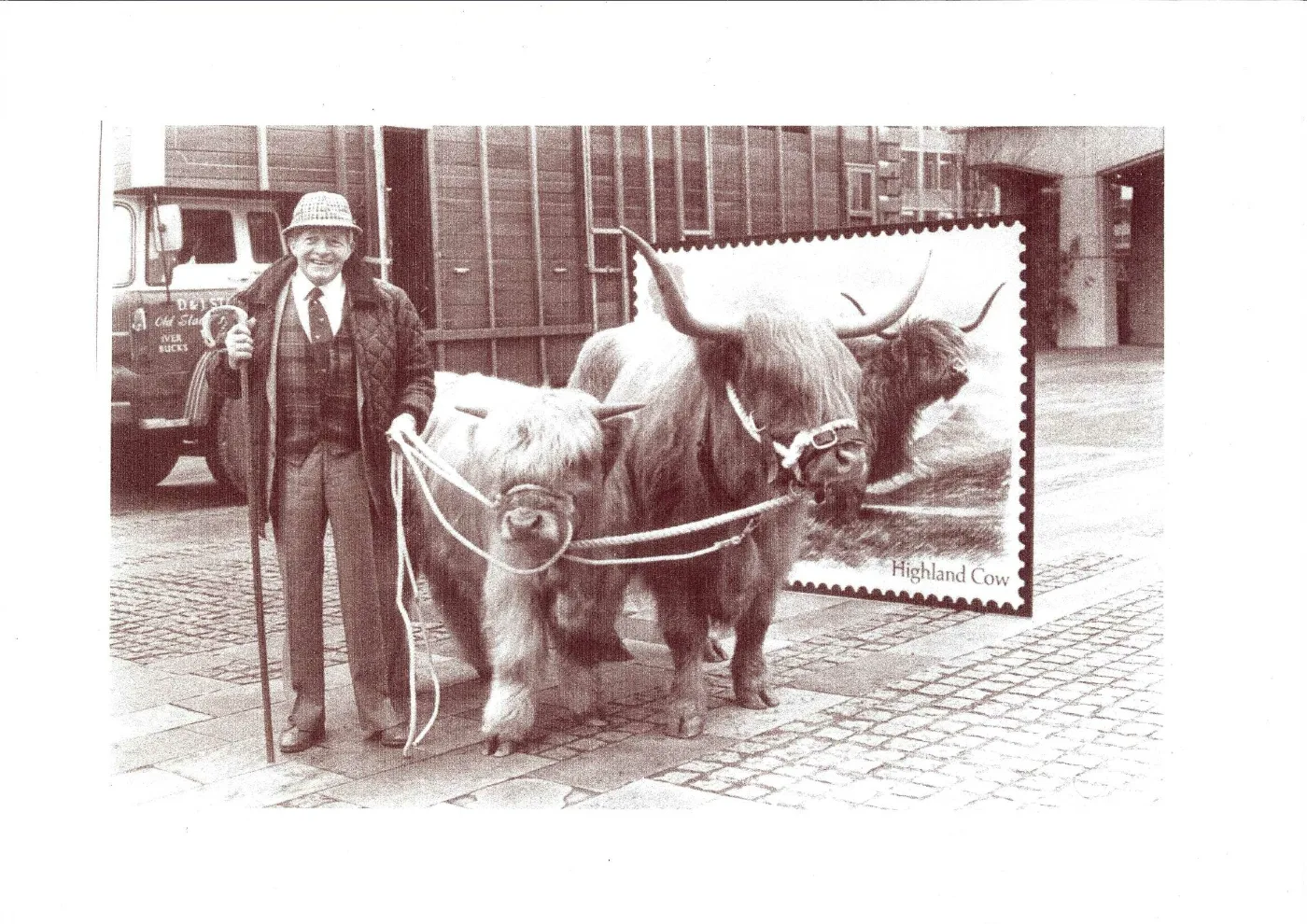
The Copas family have farmed at Cookham, in Berkshire, since 1901. Tom's grandfather ran a proper mixed smallholding, with fruit, arable crops and livestock, and his real passion was breeding and showing Berkshire pigs and Highland cattle.
Then Tom's dad, also called Tom, decided he wanted to be a farmer. "He hit 16 and thought, well, I want to be a farmer, so why am I still at school?" Tom says. "So he left school and arrived back home. I can imagine Grandpa saying something like, 'You bloody stupid boy,' along those lines. He wasn't very impressed."
A few days later his grandfather took some pigs to market, and there in one of the lots were 153 turkeys. He bought them and brought them home for his son. "It was to keep him out of trouble for a bit," Tom says. "Give him a little project to do."
That was 1957. Tom's dad reared them, then went door to door to sell them. His granny was involved in the WI, which helped. "They went to the WI to get these birds sold locally, went door to door, 'We've got a turkey for Christmas,' and that's how we got into it."
The boy who went to Bristol
Tom is the youngest of four, with three older sisters. There are seven years between him and the next one up and sixteen between him and the eldest, and all of them have helped their dad run the business at one time or another. They still help now on a part-time, advisory basis. "So it wasn't necessarily always going to be me that took it on," he says. "That's just how it's worked out."
At 18 he wasn't sure it would be him either. His dad was keen for him to go to agricultural college at Cirencester. Tom wasn't, and went to UWE in Bristol to study product design and engineering instead, which he "absolutely loved". But he kept working on the farm in the holidays, at Christmas and at the summer events, and somewhere in there he realised he wanted to come back. "I came back from university, did part-time bits, full-time bits, and here I am today, 20-odd years later."
Simon's story is a good example of what happens to people at Copas. He came for six months, to help out while they found a marketing person. Before that he'd run his own business selling ceramics and figurines, working with the potteries up in Stoke-on-Trent. That was nine years ago. He'd been a Copas customer long before, too: when he lived in London, his local butcher in Highgate sold their turkeys. Tom puts it down to the business being a family one at heart, with "a lot of contact time with the family and owners". "There's always a family thread coming through everything."
Why every bird is the same age
Everything about a Copas turkey follows from one decision, which is that every bird on the farm is the same age.
Most producers raise a single breed and pick their sizes by age: slaughter at three months for the small ones, leave the rest another month for the bigger ones. Copas do it the other way round. They raise somewhere between 10 and 13 varieties of bronze turkey each year, chosen because each one reaches a particular weight at the same age, and males and females grow differently too. Then they take them all to around 24 to 26 weeks. The smaller breeds give them the small birds and the bigger breeds give them the big ones, and every one of them has had the same amount of time to grow up.
That time matters because of what a turkey does as it matures. "Just like us, as they mature, they start to build up fat layers under the skin, and that runs into the meat and creates marbling," Tom explains. In the wild, a turkey at that age is preparing to lay and sit on eggs, so it builds up fat stores to see it through.
Once the bird has that fat layer, three things follow, and they all depend on one another. The marbling gives flavour. The fat under the skin bastes the bird as it cooks, which is why Copas tell you not to cover or baste it. And the skin becomes tough enough to be dry-plucked, without the hot-water scald that most turkeys go through, which in turn is what makes it possible to hang the birds and dry-age them. You can't do the last step without the first, and you can't get the first without time.
That's also why Copas order their birds so early in the year. They need what's called the first hatch, so that the birds are old enough by December.
Day one: being a mother hen
The planning for Christmas starts in January, as soon as the last one is wrapped up. Tom has to forecast how many turkeys he'll sell, and in what sizes, and then speak to the hatcheries about which breeds he wants. The hatchery has to have enough of the right hens laying at the right time, collect the eggs within a tight window and incubate them together, so that everything hatches within 24 hours. Ideally, the birds hatch on the morning they're delivered to the farm.
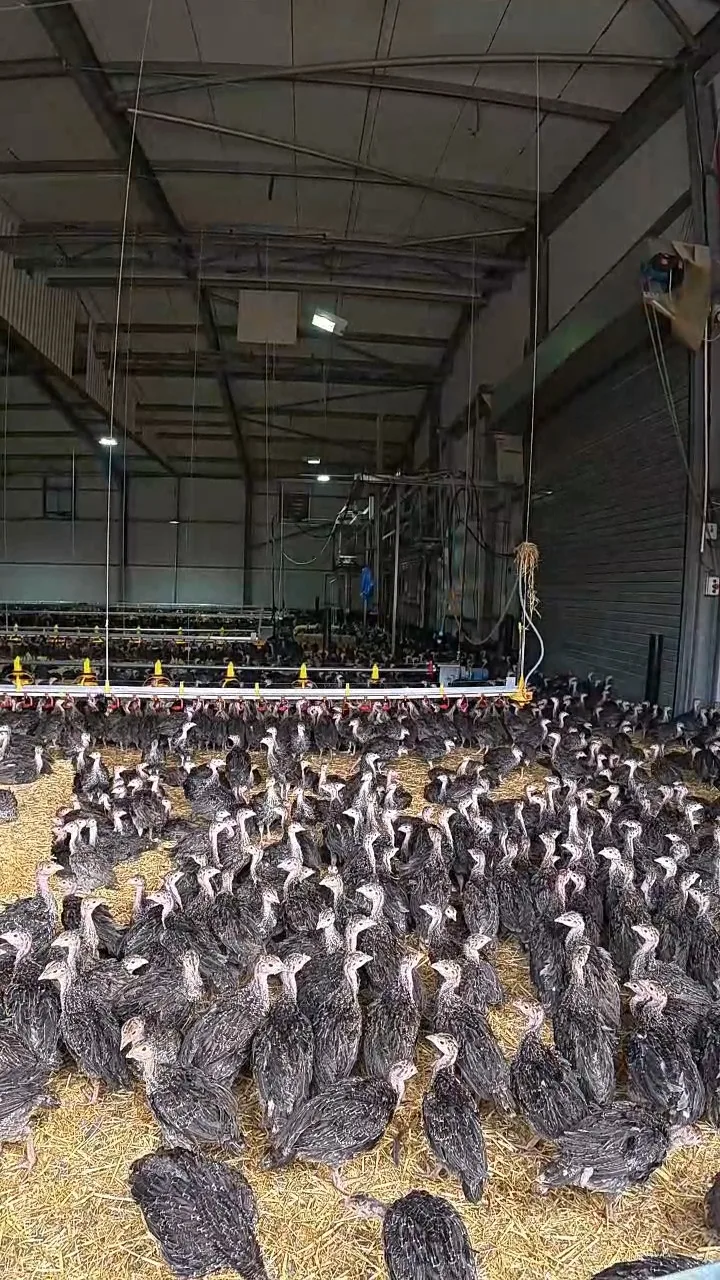
They arrive at a day old, in crates, and go into the barns. "Effectively we are being a mother hen," Tom says.
For the first week they live in metal rings on a bed of wood shavings, which keeps them warm and off the cold floor. Gas brooders hang above them, and the chicks can move in and out from underneath to get warmer or cooler. The feeders and drinkers are red so they notice them, and food is scattered on paper and egg trays, because pecking at it makes a noise and the noise makes them curious. "It's that curiosity piece coming out, one of their inherent traits," Tom says. The aim is to get them eating and drinking as soon as possible, for their gut health. Just before hatching, a chick absorbs its yolk sac, and that gives it about 36 hours of food. After that, if it hasn't found something to eat, it starves.
Not every chick arrives strong. Some come from older eggs and some from younger ones, so they haven't all hatched at quite the same time, and some have been left too long in the incubator and come out dried out and tired. Those ones end up on their backs, knocked over by the others under the brooders. When I walked round with Simon, he said the farm lads spend a good part of that first week going round the barns picking chicks up and tipping them back onto their feet. Tom explains why it's worth it: they give each one a drink of water, prop it up, and give it a chance. A day-old chick costs Copas £8 to £10.
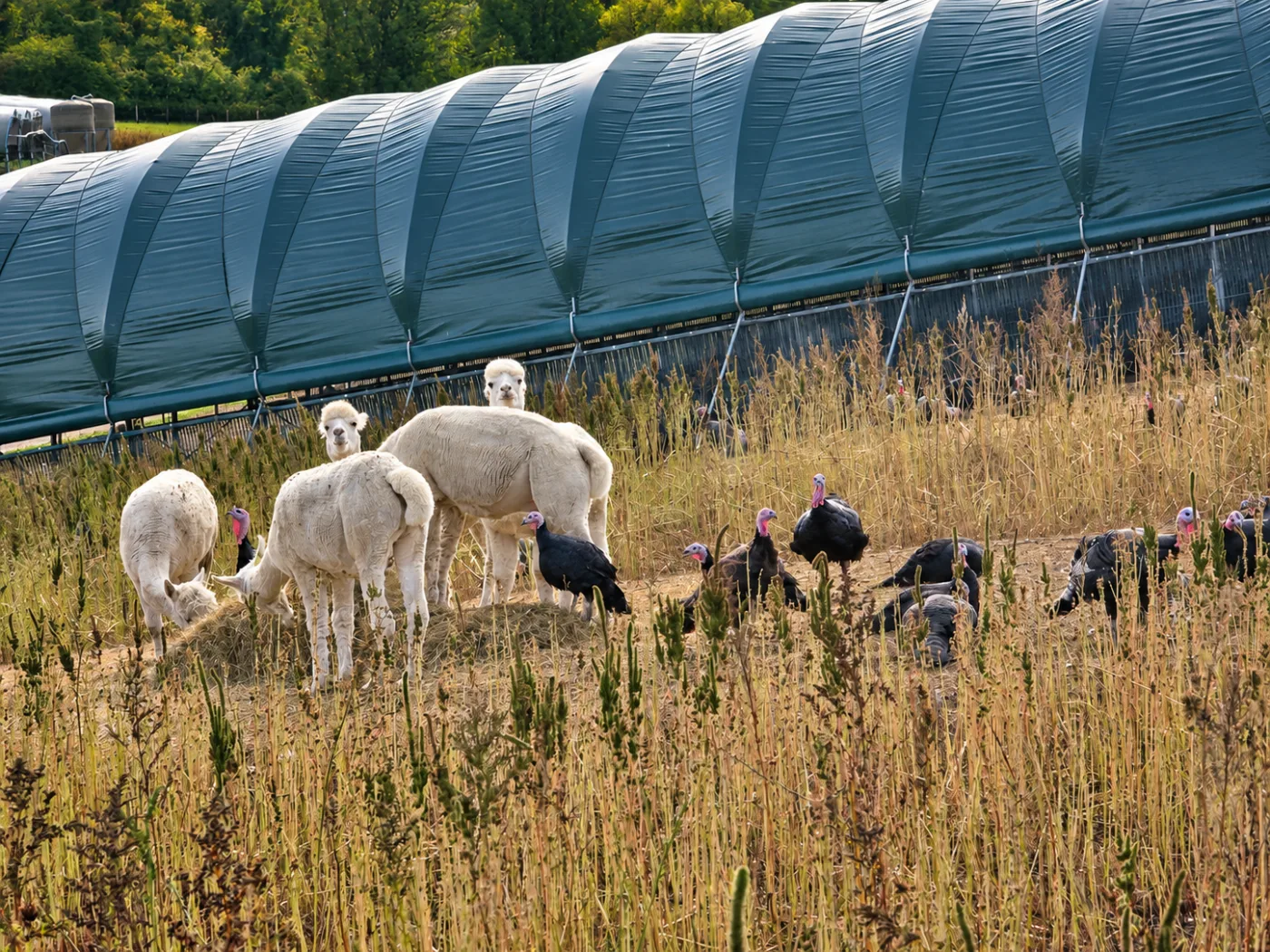
After about a week the rings come away and the birds have the run of the shed, with more feeders and drinkers. At around 14 days the windows start to open for natural ventilation. By five or six weeks the windows are open overnight, the heat is off and the birds are managing their own body temperature. Then they move out to the fields, into poly tunnels bedded with straw, where they're fenced in for a week so they learn where the food, the water and home are. After that the fences come down and they free-range until Christmas, subject to any bird flu housing orders.
One thing Tom thinks about from day one: each bird stays with the same group of mates all the way through, from the day it arrives to the end.
Life in the field
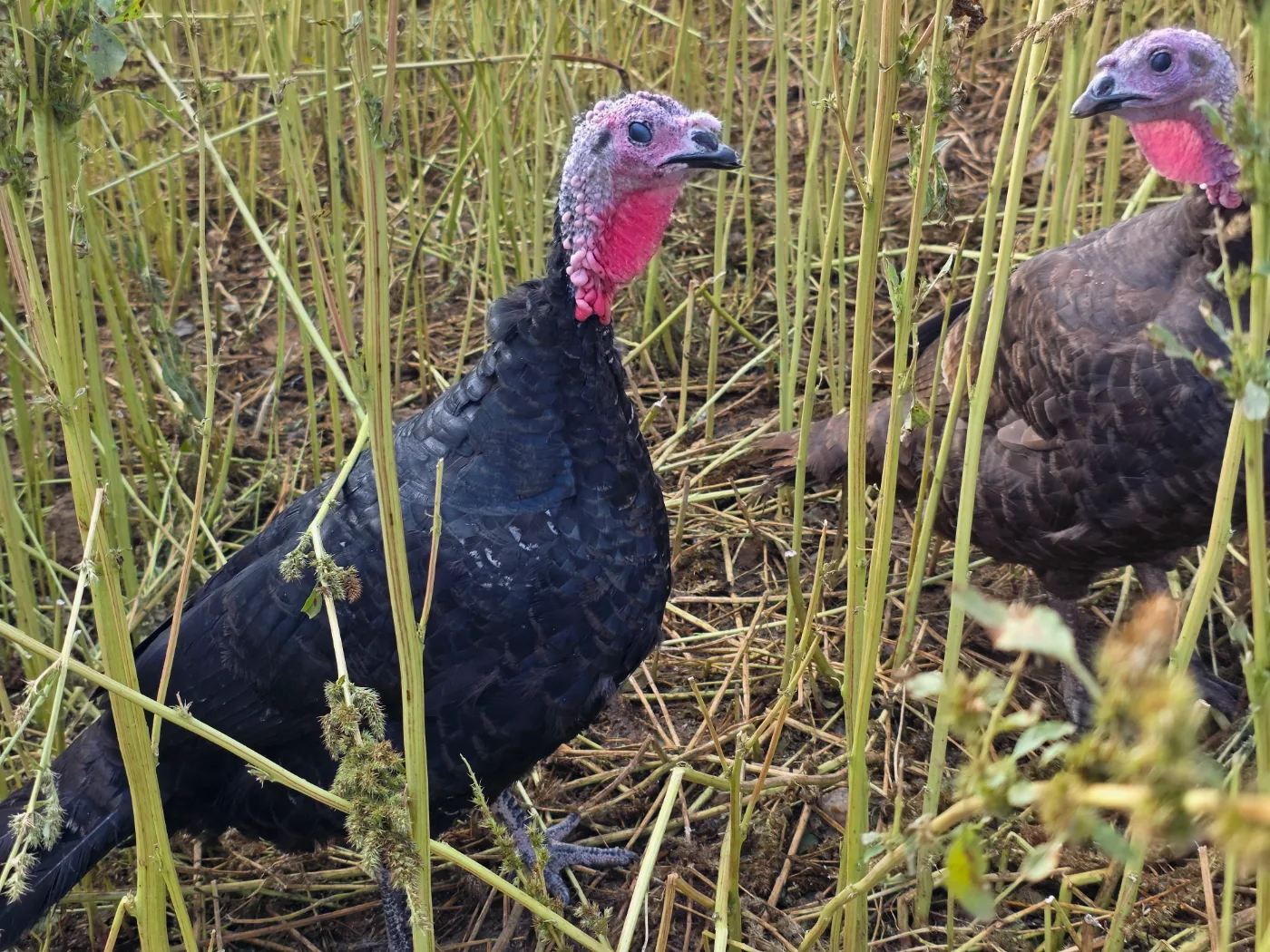
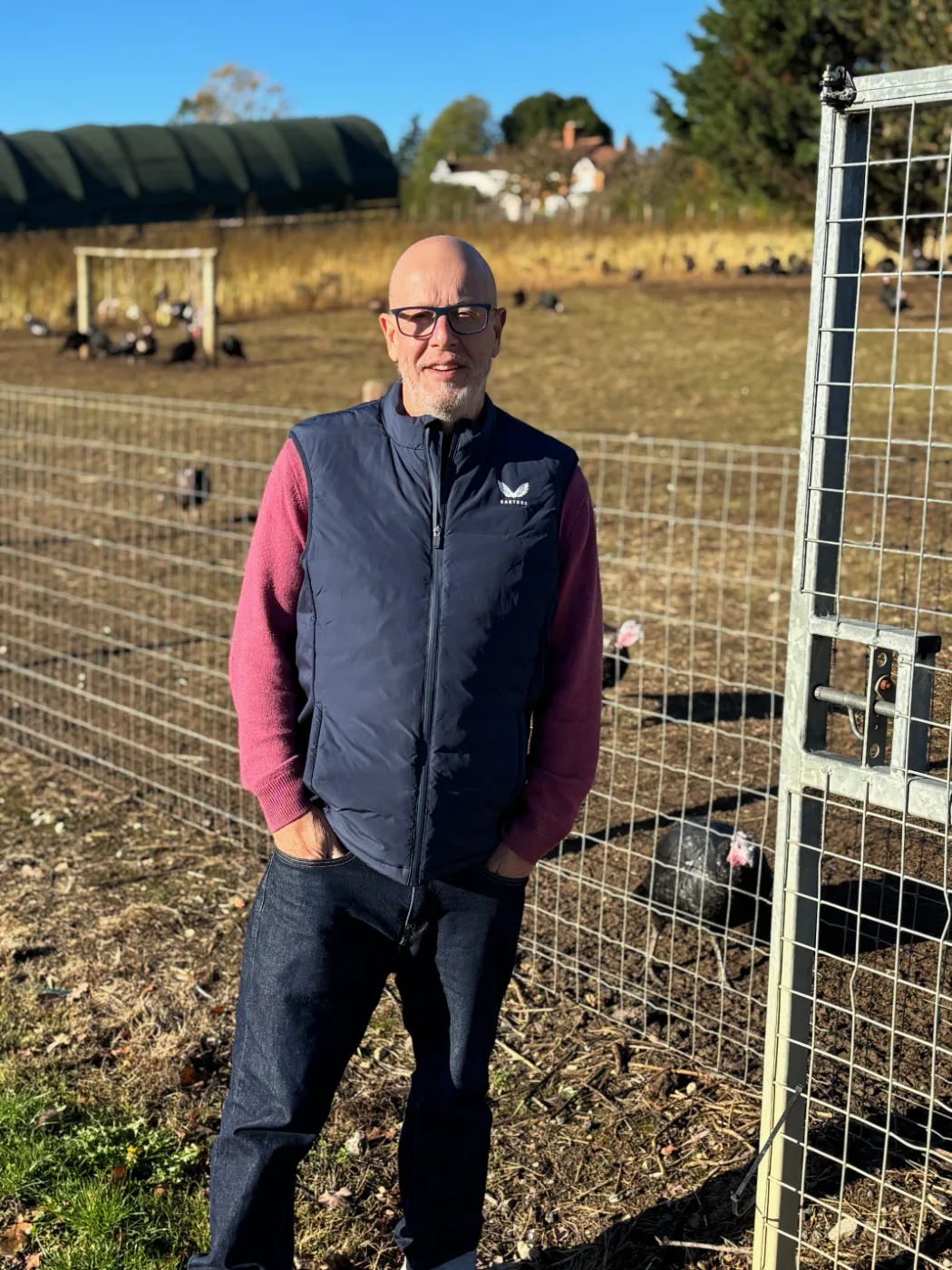
When I visited, the field Simon showed me held about 5,000 birds, with more on another site on the other side of the village. They go where they want. Some sheds were busy, others not; plenty were sitting in the shade, and plenty more were out in the scrub.
The scrub is there on purpose. Copas grow sunflowers in it and the birds eat the seeds, along with whatever seeds and bugs they find on the ground. They also get into the cherry orchard in season and help themselves to the cherries. The rest of their diet is a feed that's put out in the field. Alpacas share the fields and keep the grass down.
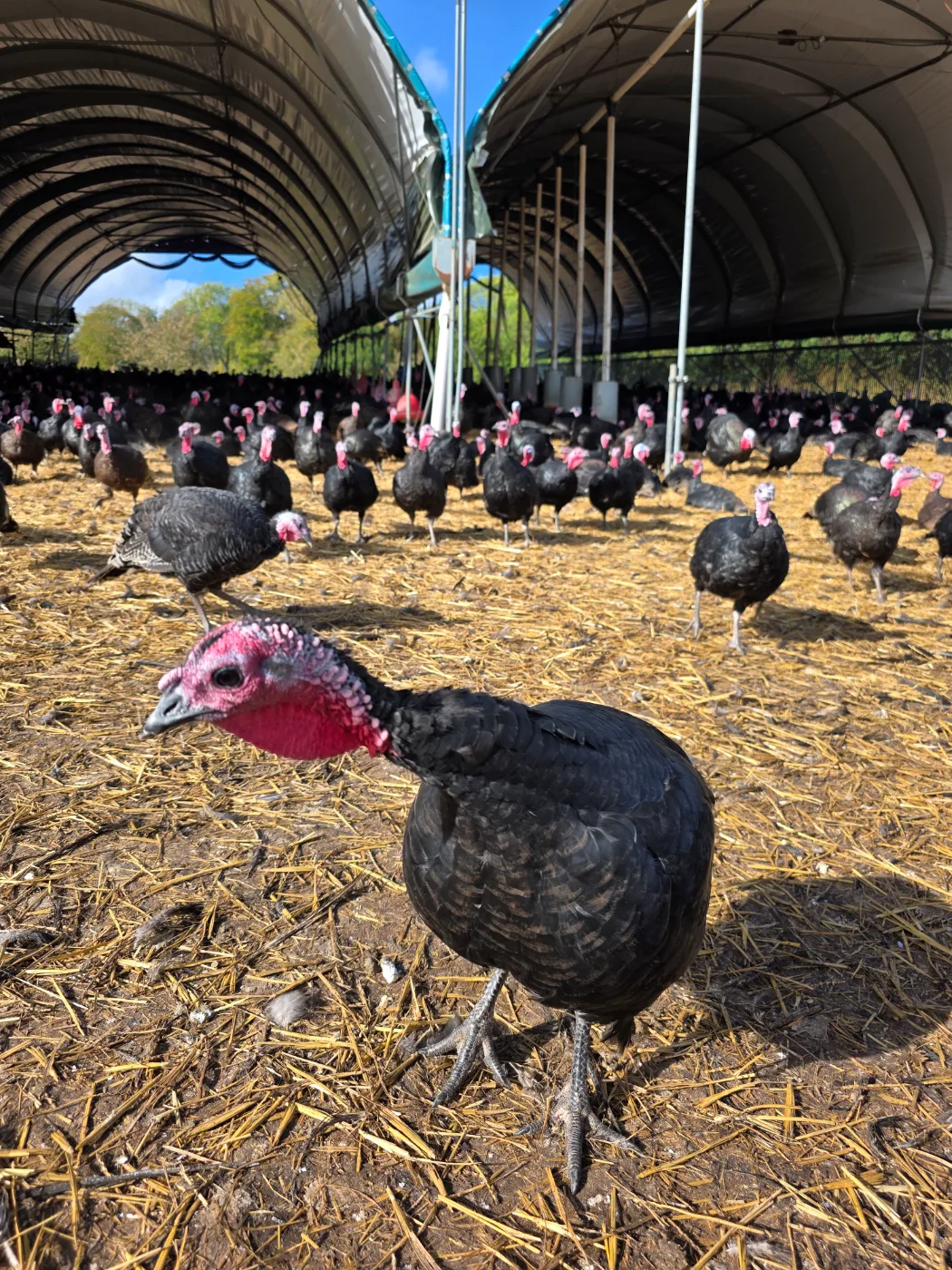
Simon pointed out something that clearly frustrates everyone at Copas. There's a lot of space, but the moment you get a camera out, the turkeys come running to see what you're doing, so every photo makes them look crammed together. "You end up looking like they're being battery farmed in this tiny space," he said.
At the end of January the sheds are cleared out. The muck and old bedding go to local farmers and back onto the land, where Copas grow the arable crops that give them their straw for next year's bedding. "We try to be as self-sufficient as possible," Simon said.
The turkeys that play music
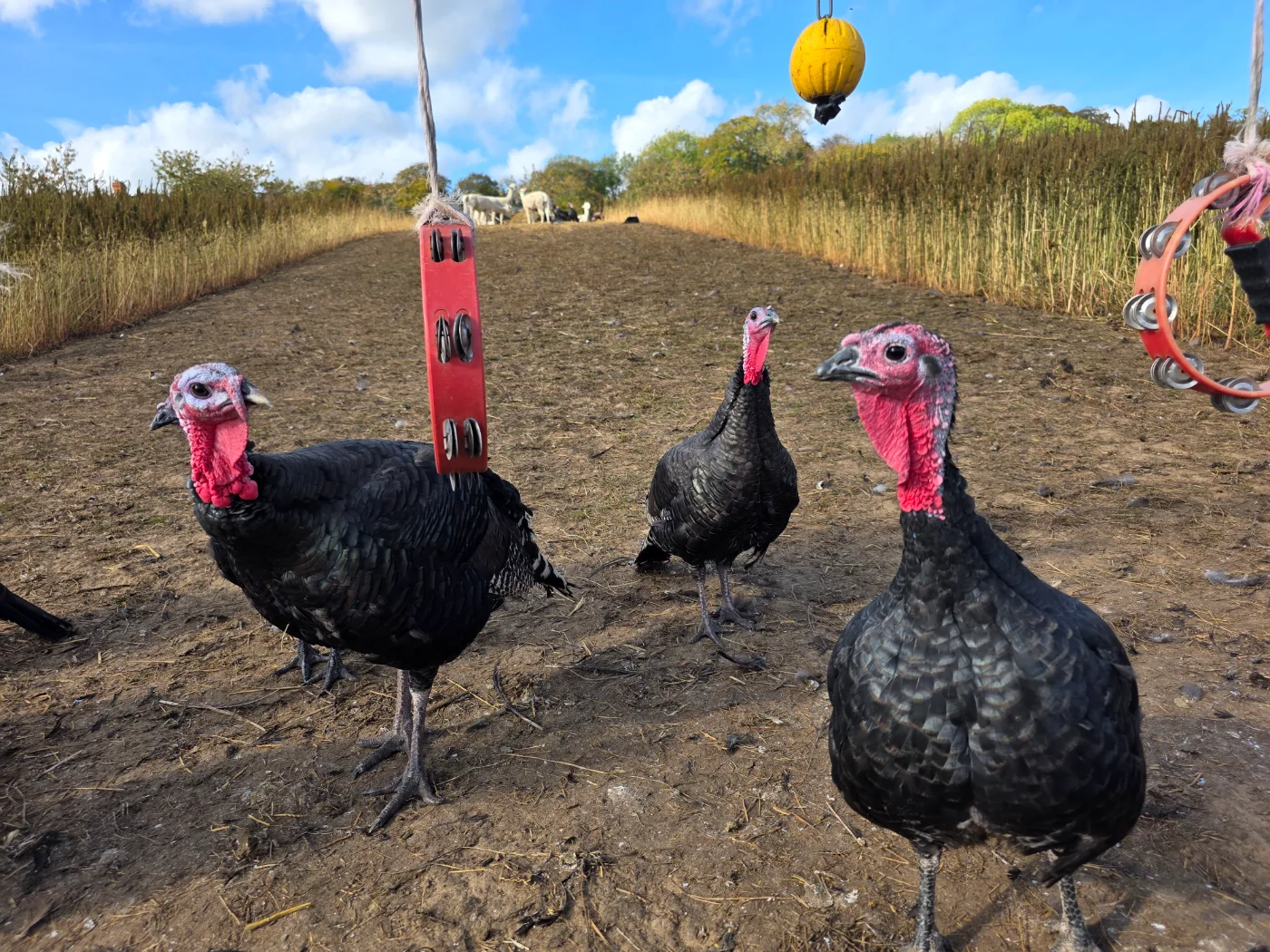
In one of the fields the turkeys have a set of musical instruments, and when I was there about a dozen birds were playing them. Not a tune you'd recognise, but they were definitely playing.
The idea came from the days when Copas reared turkeys in barns with corrugated tin sheets round the sides. "You'd always hear turkeys in the background tapping away, going tap, tap, tap, tap," Tom says. "And I wondered if they were doing it because they liked the noise, and whether they'd do it with any other musical instruments." It's enrichment, something to keep them busy and stop them getting bored. They went up about five years ago and get topped up every year; Simon told me the birds like the colour red, which helps.
They've tried xylophones, tambourines and triangles, and not all of them have survived. "Stuff just went missing," Tom says. "I don't know where. It's kind of Chicken Run vibes. They're up to something."
Talking turkey
Simon told me that Tom can make a noise at the turkeys and they'll all talk back to him. Simon can't do it, though Tom says he tries.
I'd expected to be surrounded by gobbling. I didn't hear a single gobble all morning: lots of chirping and chatter, but no gobbles. Tom says that depends on their age and the weather. Turkeys don't much like strong sun, so on bright days they keep to the shade, and on gloomier days they're out and about.
"It's quite infectious," he says. "They keep gobbling at you and you end up gobbling back, and they all go." As they get older, it becomes more of a conversation. "You can talk to them and they'll talk back. You go, 'Morning, turkeys,' and they go back at you."
That comes with confidence, he says, and with a bit of testosterone as the males get older and more boisterous. Turkeys have real personalities, and they're the opposite of chickens. "Chickens are terrified of you, they just run away. Turkeys want to have a peck at you." Put a ladder up in a shed and by the time you come back down, they're all pecking the ladder. Stand around long enough and they'll start on your boots. Film crews get their tripods pecked.
Why don't we see bronze turkeys in supermarkets?
Simon's version was that the supermarkets only sell white turkeys because you can't see the feather stubs on them, and people don't like to be reminded that their meat was once an animal. Tom says there's truth in that, but the full story goes back further.
Turkeys are naturally bronze or black-feathered. When you pluck a dark-feathered bird you can get a bit of ink staining under the skin, or the odd bit of quill left behind. "In the '80s, the supermarkets, or the buyers, didn't want to see those stubs," Tom says. "So they bred turkeys to be white." It worked so well that the bronze almost died out completely. "Everyone thought, well, turkeys are white, and the consumer wants the turkeys to be white."
What saved the bronze was a small group of producers who went round collecting up the few breeds that were left, including backyard birds, and kept the genetics going. Those are the bloodlines Copas still raise today. As for the little dark stubs on a bronze turkey, Simon's advice is not to worry about them. They burn off in the oven.
Is a Copas turkey worth the money?
A Copas turkey costs around £120, and with the cost of living the way it is, it's a fair question, one I asked myself last year before I ordered.
Tom's answer starts with what a supermarket bird actually is. The commercial producers use some of the same breeds Copas do, because there aren't many turkey strains to choose from. The difference is the age. "They say, we want a 5-kilo turkey, and I've got 16 weeks to grow it," Tom explains. That's done to hit a price point: the chick costs this much, it'll eat this much feed, and the sums work out.
"But the reality is that at that point, a turkey is basically a teenager. It's just building its frame. So yes, there'll be 5 kilos of turkey, but it'll be 5 kilos of mainly turkey frame with very little meat on it." A young bird is only about to start putting on muscle. You can spot it on the shelf, he says, where the breast is narrow and pointy rather than full.
The labels don't always help either. To be called free range, a turkey has to spend half its life outside. Birds come out of the sheds at five or six weeks, so a 12-week-old bird that's been outside since six weeks is technically free range, and it can be bronze-feathered too. "But really, that's a very infantile turkey," Tom says. It might weigh three and a half kilos, which ticks a box for people who want a small bird for a small Christmas. The problem is that no breed of turkey naturally grows to three and a half kilos at a proper age, so the only way to get one is to kill it young, before it's built its muscle and before it's laid down any fat.
At Copas, 5 kilos is the "bread and butter" bird. They sell from 4 to 10 kilos, and the 4-kilo birds are the ones that "haven't quite made it", the small end of the natural spread. So if you put a proper 26-week bird next to a young supermarket bird of the same weight, which gives you more meat? "More, probably," Tom says. Simon adds that the birds aren't pumped with water or anything else, and that once you carve one, you can see how much meat there is compared with the carcass.
Tom's own way of looking at it is cost per serving. "Go to a butcher and a steak each is going to cost you £25," he says. "This is coming out at £7 or £8 a serving. And that's before the leftovers, which are just the bonus."
Simon says the other proof is that people come back. Copas get customers who try another producer one year and return the next, saying they made a mistake.
Planning a Christmas you can't move
This, to me, was the part of the business that sounded hardest. Copas take orders all year: last year's first order for Christmas came in on 15 January, the shop goes back online in early January, and before the official launch on 1 October this year they'd already sold around 100 birds. Everyone orders a weight. Nearly everyone wants their bird on the same day or two just before Christmas. And nobody, Tom included, knows exactly what weights he's got until the birds are processed in mid-December.
Within any batch of turkeys, the weights fall on a bell curve. About half of them land where you want them and a quarter fall either side. So Tom lines up the next variety to fill the gaps, overlapping the curves. Where a shed or poly tunnel holds a single strain, they can weigh 50 birds and get an average. In a mixed flock that's impossible. "You go, well, that's the poults we ordered, and hopefully the hatchery sent us the right ones," he says. "They all look like turkeys at that stage." The weather plays a part as well, Simon told me: some years are heavy years and some are light, and one year they had a load of 4-kilo birds and very few at the top end.
So they plan in some overage, and when a weight band runs short, there's a bit of shuffling. "If we're short of sevens, the people who wanted sevens get eights, and the people who wanted sixes get sevens," Tom says. The rule, as Simon put it, is that Copas always go up, never down. Order a 5 and they'll never send you a 4; you'll get a 6. Customers who get a bigger bird don't pay any extra for it. "The main thing is your total numbers," Tom says, "and hopefully the fox doesn't eat too many."
By mid-December the birds are weighed and hanging in the cold store, and at last they know exactly what they have. Then it's a matter of matching birds to orders.
Tom has a line he uses about the economics of all this. "If you went to the bank manager and said, I've got a brilliant idea, I want to be a turkey farmer, I need a load of cash to do it, but I can only sell them once a year, on one day, and the day after that they're worth 30% less..." He doesn't need to finish the sentence.
From 50,000 turkeys to 5,000
It wasn't always this size. When Tom was at university, around the farm's 50th anniversary, Copas were aiming for 50,000 turkeys and got just short of it. They were supplying about 230 butchers all over the country. That was 2008 and 2009.
Then the high street started to struggle, and it has never really recovered. "We were getting left over with more and more turkeys each year," Tom says. On top of that there was a lot of competition, some producers undercutting, and butchers wanting a bigger margin at Christmas, one of the two times of year, with summer barbecue season, when they make most of theirs. And Tom has to commit to his numbers in February. "Then come December, there's 2,000 boxed turkeys looking at you."
So they did an 80/20 review of who they supplied, and found that 20% of their volume was taking 80% of their time. They'd been palletising and sending five turkeys at a time to a customer in Scotland, in the hope that the account would grow, and it never did. They almost halved the number of stockists, to about 150, and settled at around 36,000 to 38,000 birds a year, as well as processing birds for other people. The plan was to focus on selling direct to customers.
Then came what Tom calls "the trifecta of Brexit, Covid and bird flu".
The staff problem was the hardest. Copas had always relied on seasonal workers: workers from New Zealand and Africa who were used to farm work, then a lot of Polish people for a number of years, who were "fantastic", and then Ukrainian teams, who were brilliant until the war in Ukraine. Brexit brought visa rules that made no sense for a business like this. Workers already in the country, who'd finished picking fruit and wanted to come and pluck turkeys, couldn't, because their visa didn't cover a second job. They'd have to go home, reapply and fly back, and by then the season was over. "They were here in the country, wanting to work," Tom says. "It was just, really?" Every seasonal worker had to come through an agency, and between visas and transport it cost about £350 a person to get them here. Copas needed 120 of them each Christmas, all to be trained, housed and fed. During Covid, some had to be quarantined on arrival at Christmas. The staff who used to come back every year had found year-round work elsewhere.
In the 50,000-bird years, the plucking alone had needed 350 piece-rate pluckers for about ten days' work. "It was a real challenge trying to find them," he says.
The red tape grew too. Copas were exporting birds to Europe at the time. And because of the volume, they were treated as a year-round processing plant that only worked three weeks a year, so every annual audit and every piece of compliance had to be done at the same time as training a completely new team. "And there's no moving Christmas," Tom says. "It's a definitive deadline."
All the while, bird flu hung over everything. Like a lot of farms, Copas run on feed credit: they pay the feed supplier up to a point in the year, the supplier gives them credit after that, and they settle up in January once the butchers have paid them. "We had the best part of a million quid's worth of feed credit," Tom says. "And 10 grams of infected wild bird faeces could take out everything."
Smaller, and better for it
So they got smaller, and sold only direct. Tom says he wouldn't go back.
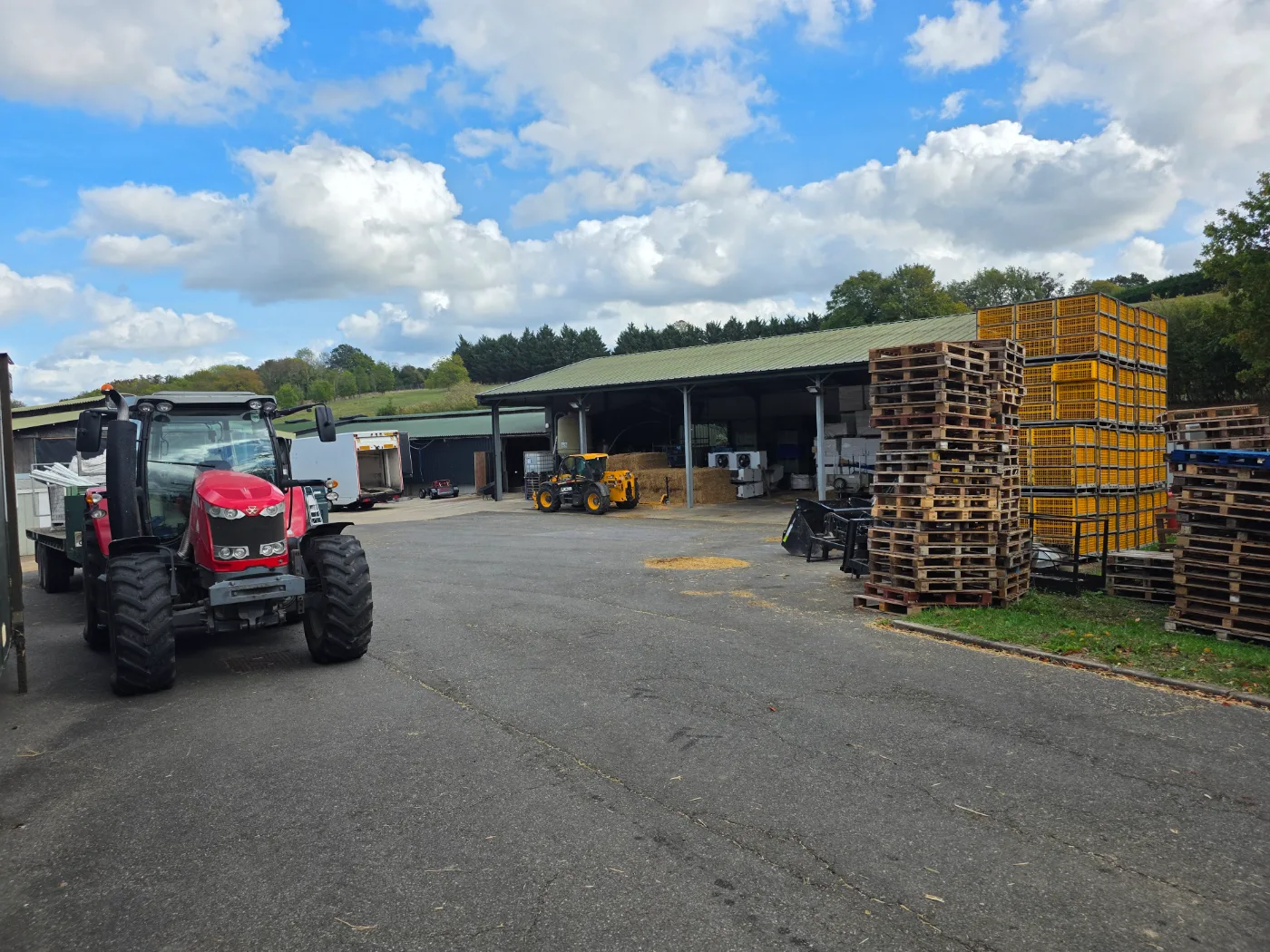
"Nowadays we do the birds for our own market, and we do them exactly how we want to do them," he says. "We've noticed the quality of what we produce is better, because we're not under so much pressure." Christmas now takes a team of around 18 to 20 people rather than 120. "We get the same guys back year on year and look after them really well. It's much more sustainable, and much better on my blood pressure. We've always got time to get it right, and to get the customer service right."
Selling direct also means a relationship with the people who eat the birds. "Once you get a customer converted, hopefully they're your customer for life, because it's a really good product that does the job on Christmas Day."
The capacity they freed up has gone into something new. This is the first year there have been turkeys at Copas all year round. The barns used to stand empty from January to May. Now they rear birds for other businesses, including Gressingham and Daylesford, for people who want turkey outside Christmas, and that has brought in some other revenue.
The way people buy has changed too. Crowns and breast joints used to be about 20% of sales and are now about 25%. Tom thinks it's partly a post-Covid thing. "People used to gather for a few days, eat the turkey, and then on Boxing Day everyone had a plan to go through the leftovers. I think people realised they didn't all need to be together for that long. So they get a smaller turkey that does the job on Christmas Day." The big males help there as well. A stag can reach 12 kilos, enough to feed 24 to 26 people at half a kilo each, which is more turkey than most people want, so Simon said many of them become crowns and breast roasts.
The customers are changing as well. Copas aim for about 20% of their orders each year to come from new customers. Before Covid there was a pattern to it, Simon told me: people ordered a turkey roughly every three years, when it was their turn to host.
Keeping birds apart, and the problem with hatcheries
Copas only rear turkeys. Their geese are bought in from another producer and their chickens are produced in Derbyshire. That's partly about bird flu and partly about their accreditation, which doesn't allow multi-species sites. Chickens tend to be reared all year round, Tom explains, so a chicken farm always has birds of different ages, each carrying its own bugs, "like going from nursery to school". Keeping everything turkey and everything on the same cycle is simply best practice.
They've been lucky with bird flu itself. There have been no cases at Copas; the nearest was some swans in Windsor, one January about five years ago. "If you're in East Anglia, or down in Devon and Cornwall, or in Scotland, on the paths of migrating birds, it's a very different picture," Tom says. "It's a real challenge."
I asked whether they'd ever hatch their own. Tom says it's a whole other business. You'd need a hatchery and the equipment, which is the easy part. Above that you need parent stock to lay the eggs, and grandparent stock to produce the parents, and above that the pure genetic lines, all kept on separate sites so that one outbreak of bird flu can't wipe out the genetics. When Tom came back to the business there were five or six turkey hatcheries in the UK. Now there are two.
It's consolidation, he says, but it's not without risk. Geese have gone the same way: no one breeds geese in the UK any more. They all come from Germany, because the British breeding pool got too small to keep crossing the lines, and the genetics were getting exhausted. Heritage turkey breeds do still exist, like the Slate, the Bourbon Red and the Narragansett, but mostly as ornamentals. "It's all there," Tom says, "but you've got to have the demand to warrant building up the supply chain."
The last day
Turkeys are killed and processed on the farm, and Tom was open about it. The most important thing is keeping the birds calm. They use light and dark to walk the birds in rather than drive them: when the lights go down the birds think it's night and settle, and lights draw them forward. The area is kept shaded and dark, and the birds are still with the group they arrived with. They're stunned, then bled.
After that the big tail and flight feathers come out, then a plucking machine takes most of the rest, and finally the birds are dipped in wax, which is peeled off to take the last of the feathers. There's no hot-water scald at any point. Then the birds are hung in the cold store to age. At Christmas, one whole block of farm buildings turns into a cold store, running at about 2 degrees.
How to cook it: do less
This was the part I most needed to hear.
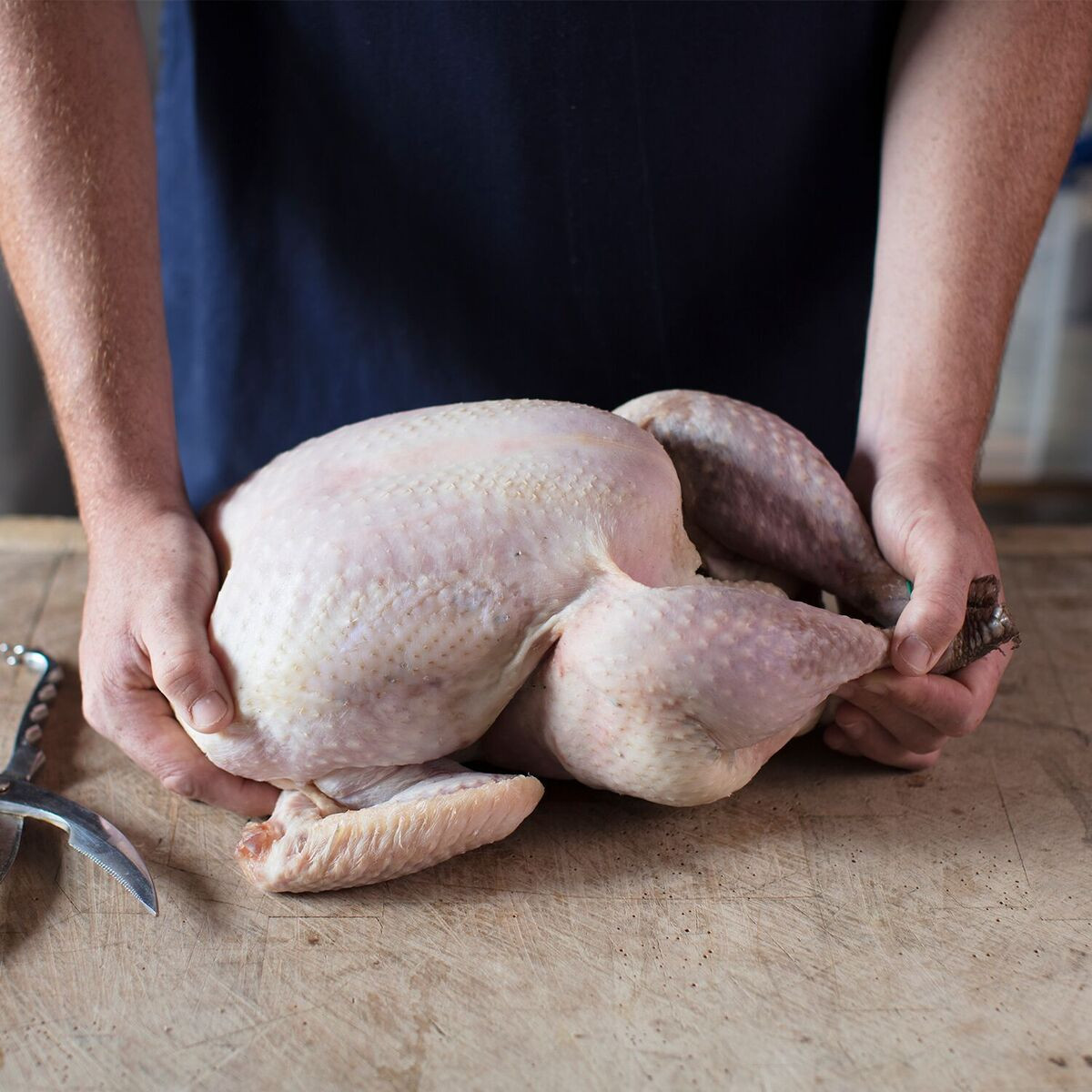
A lot of the usual turkey advice, Tom says, is borrowed from other meats and doesn't work. Long, slow cooking is fine for a shoulder of lamb, which has plenty of fat to render down and keep it moist. A turkey doesn't have that, especially a commercial one killed before it's laid down any fat. "I don't know how people ever thought that was going to work," he says.
He's not convinced by brining either. He once ran his own experiment, wet brine against dry brine on some of their chickens, both overnight. The dry-brined one came out much tougher, because the salt had drawn so much moisture out. His conclusion was that he'd probably left the dry brine on too long. And he'd tried brining chickens and found it a pain, "so how are people going to set about brining a turkey?"
And turning the bird over halfway through? "Mum always used to preach about it," Tom says. In theory it gets the juices from the back running round the rest of the bird. "But you've got so much going on on Christmas Day. Do you really need to? You need the right tools to turn it over, and when you do, the breast gets squashed flat and it looks a bit funny."
At the tasting events he and Simon run, they do almost nothing to the birds. "We're just chucking salt on the turkey and putting it in the oven, and people go, 'Oh, that tastes brilliant,'" he says. "We've done the work already. We've looked after the turkey, it's old enough and it's been processed the right way, so you don't have to worry about it."
The method is this: salt it inside and out, roast it at 180 degrees until the inside reaches 68 degrees, then leave it to rest for an hour. For a typical bird, Simon told me, that's about an hour and 45 minutes. The turkeys come with a pop-up timer, and thanks to their natural fat layer they don't need covering or basting. "Worry about other stuff," Tom says. "Worry about the taste."
I confess I didn't manage it last year. I'm so used to making a big production of Christmas dinner that I still pushed butter and seasoning under the skin, and I tore the skin doing it. Doing nothing just felt wrong. Tom has no such trouble. By Christmas, he says, he just wants to stick to what he knows.
The madness
From about 19 December, everything at Copas ramps up. On the 21st they ship every home delivery order, about half of all their turkeys, for delivery on the 22nd. The 22nd is also the drive-through. You drive in at one end of the yard, give your order number, and by the time you reach the other end your box is ready and you're off.
On the 23rd, one of the big barns becomes a Christmas fair, with festive lights, local food and drink stalls, a choir, a brass band and the alpacas out. You walk round the stalls, pick up your turkey at the end and head home. For people who can't get to Cookham, there are about 30 click-and-collect points at local businesses, including around 19 Hillier garden centres across the South East and Rebellion Brewery, where you can pick up your beer and your turkey at the same time.
By 8pm on the 23rd, they're done. Simon compared it to crossing the bridge at the end of I'm a Celebrity: "You haven't eaten properly and you're sick of the sight of everyone. That's us on the 23rd of December."
Tom says it's a lot calmer than it used to be. "Those last four or five days are quite intense, but since we stopped supplying the butchers and started focusing on direct to consumer, it's not war. It's a lot more manageable."
On the 24th they send whatever's left off to the deep freeze. Even then, he never quite switches off. "You're supplying food to people, and you believe you've done everything to the best of your ability to get it to them fresh. But until the feedback comes in in the new year, you don't really go, OK, that was all right." He waits it out. "You get through the first week of January and it's pretty good. Let's just wait till next week."
More than turkeys
There's more to the Copas family than turkeys. They own Remenham Farm, on the bank at the start of the Henley Royal Regatta course, where the business runs hospitality enclosures during regatta week. Around the farm, some of the barns are let to three car mechanics, including a mobile Porsche specialist, and elsewhere the family has property where classic cars are stored. Some of the farmland is sublet to an arable farmer, and some of it grows the farm's own straw.
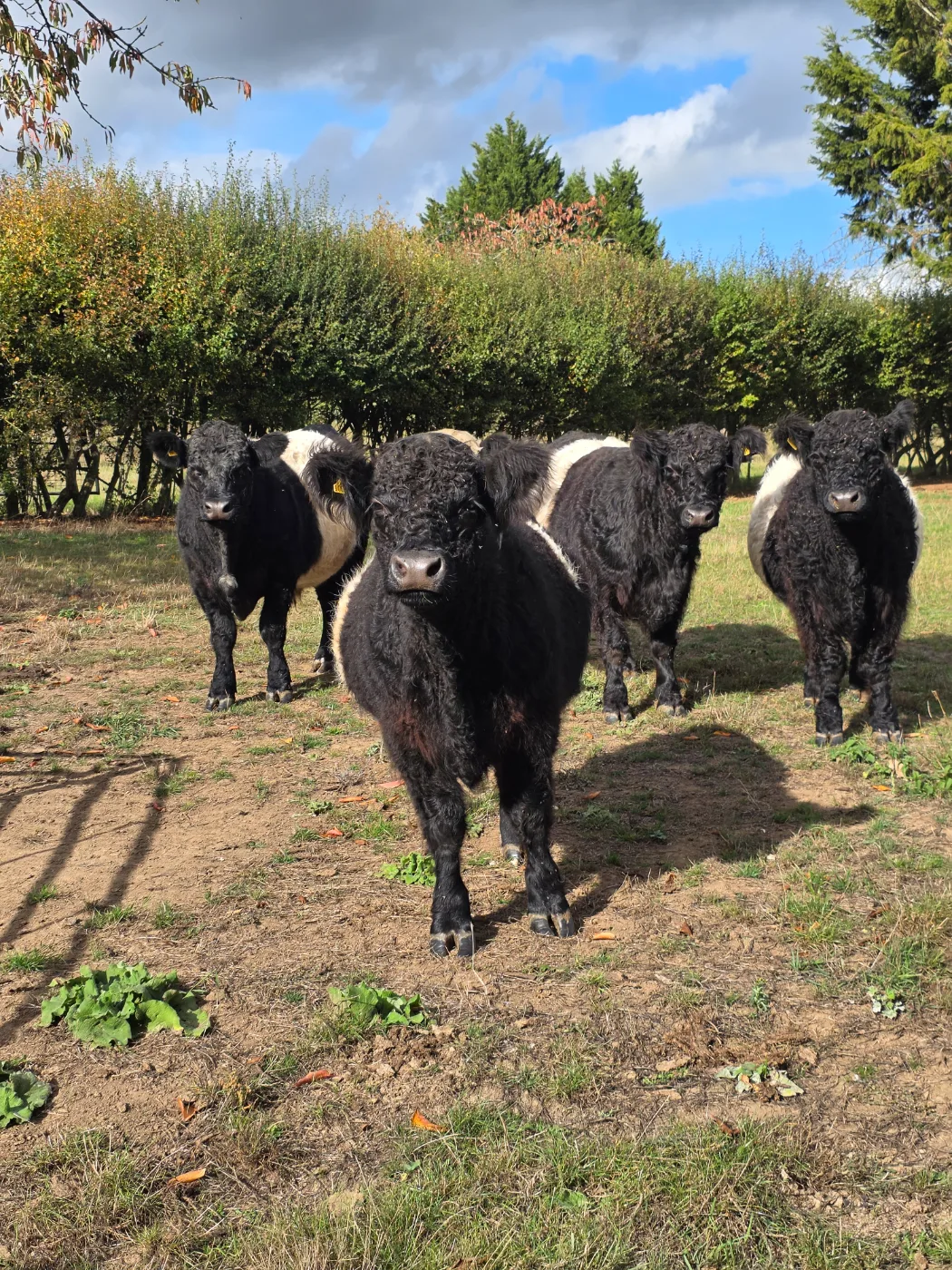
There's a little meat beyond turkey too. Olly, the farm manager, keeps his own flock of sheep, and Copas sell his lamb at Easter. There are a few Belted Galloway cattle as well, which Tom would like to do more with. "I think they eat the best, and they're delicious," he says, "but they're quite small. There aren't many steaks on them, unfortunately." His own Christmas, by the way, is turkey. A joint of beef waits for New Year.
Where Tom shops
I always ask producers who else I should talk to, and Tom's list was a good one.
At the top were Harrow & Hope, the English sparkling wine producer just outside Marlow run by Henry and Kaye Laithwaite, which Tom calls a "really positive story" of a business that's growing. Next was Rebellion Brewery, whose story he sees as much like Copas's own: they used to supply the supermarkets, and chose to pull back to a local radius. Tom remembers being at university in Bristol and finding Rebellion on the shelves. "I was like, what's going on? This is my local!"
For bread, it's Big Dog Bakery in Maidenhead, which is only open Thursday to Saturday mornings and has a queue. In my experience the places with limited hours are nearly always the good ones. For pizza and sandwiches, it's Presto, also in Maidenhead. And for Italian groceries, his favourite is the Italian deli in Maidenhead, which also does pop-ups.
You'll find some of them on myfoody already. I'll be going to find the rest.
Ordering a Copas turkey
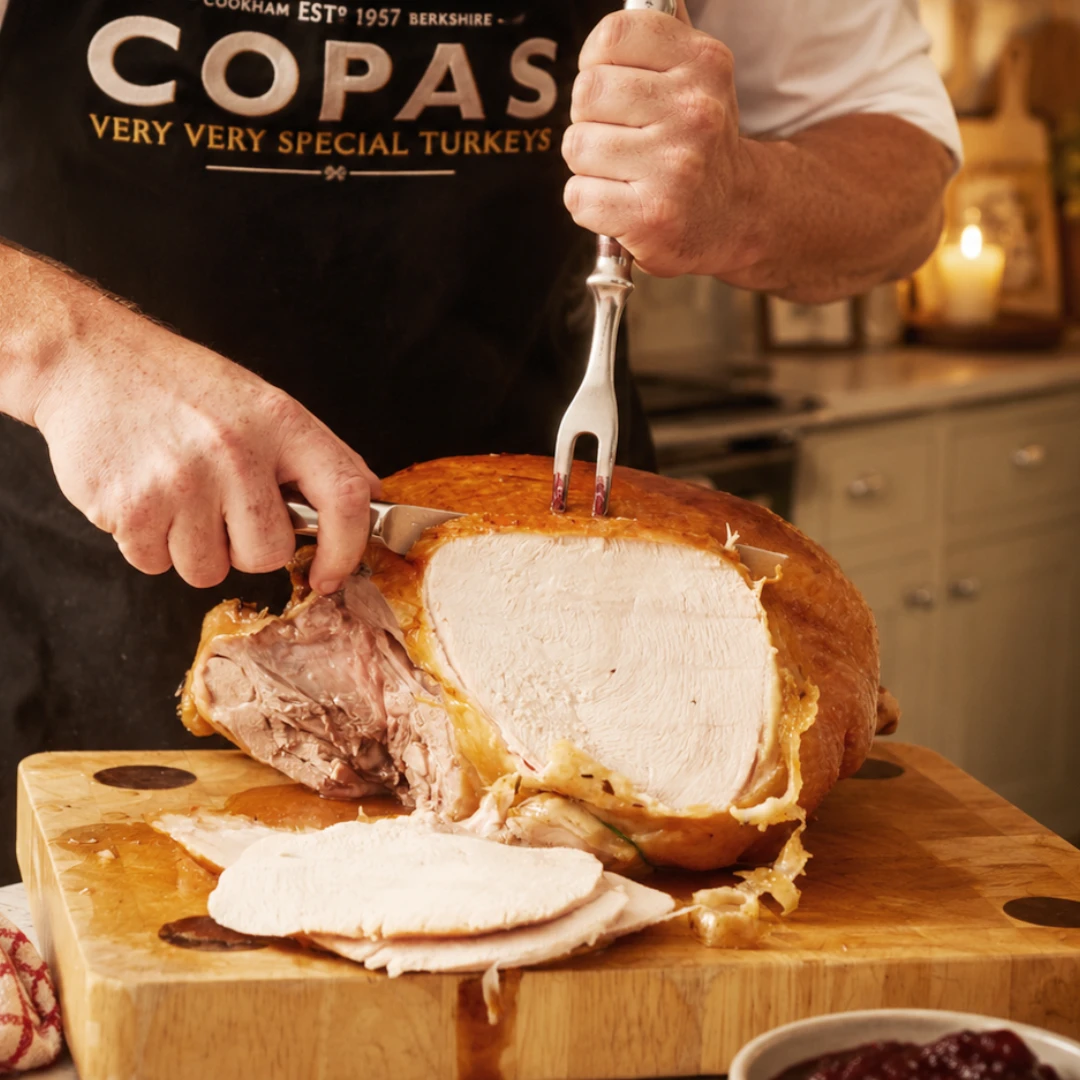
Copas turkeys are sold direct from the farm shop website, in sizes from 4 to 10 kilos, plus crowns and breast joints. Orders open in January, and the official launch is on 1 October, but the most popular sizes do sell out, so it pays to order early. You can have your bird delivered on 22 December, pick it up from the drive-through on the 22nd or the Christmas fair on the 23rd at the farm in Cookham, or collect from one of their click-and-collect points. Order from Copas
If you've had a Copas turkey, add a tip to their myfoody listing so the next person knows what to ask for.